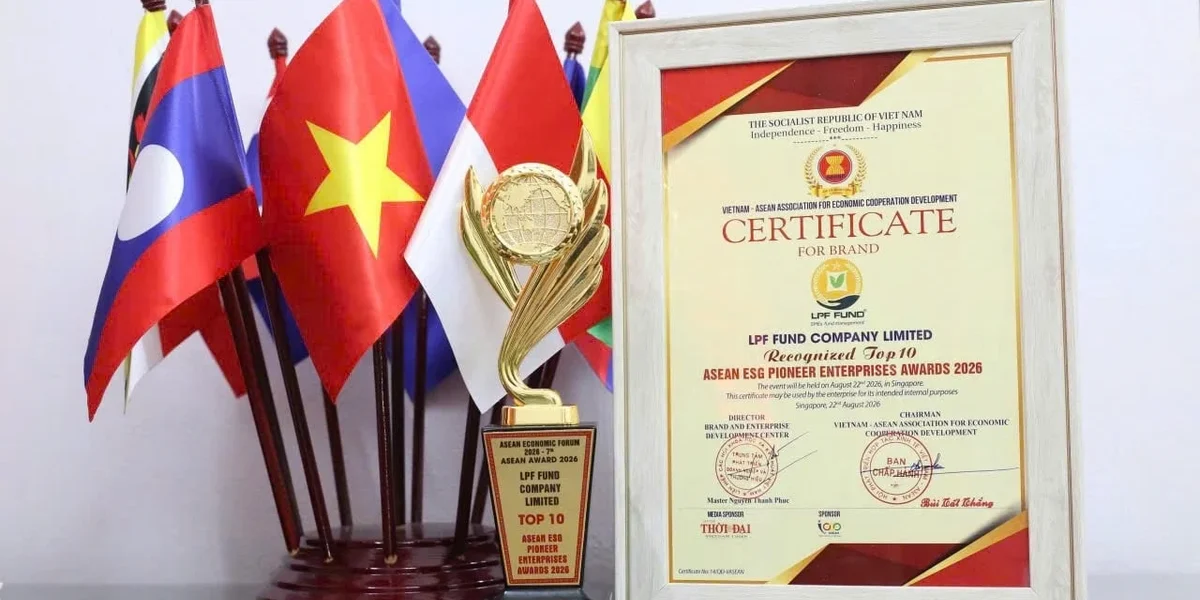
Building on the recognition at the ASEAN Award 2026, LPF Fund aims to connect standards, data, and resources to establish an ASEAN ESG capital community for sustainable agriculture.
Being honored as one of the “Top 10 ASEAN ESG Pioneer Enterprises 2026” at the ASEAN Award 2026 ceremony in Singapore demonstrates LPF Fund’s consistent efforts and strategic direction in its journey toward sustainable development.
This milestone acknowledges the path LPF Fund is pursuing to bridge ESG standards, build data systems, standardize projects, and develop green capital sources for sustainable agricultural projects.
However, for LPF Fund, the value of an award lies not merely in the title. What matters more is the action taken following that recognition.

Certificate and trophy of the ASEAN ESG Pioneer Enterprises Awards 2026 presented to LPF Fund. Photo: LPF Fund.
Accordingly, LPF Fund continues to pursue the goal of transforming ESG from directional principles and commitments into concrete projects, backed by verifiable data, measurable impact, and investment structures capable of attracting long-term capital.
From Vietnam, LPF Fund aims to gradually connect, build, and expand an ASEAN ESG capital community, moving toward linking with international financial resources.
Building an “Infrastructure of Trust” Between Projects and Green Capital
ASEAN is one of the world’s most dynamic regions for agriculture and food production. It is also an area increasingly impacted by climate change, resource depletion, and new demands from international markets regarding green development, emissions reduction, and supply chain transparency.
This transition requires substantial financial resources. In reality, however, a significant gap remains between the demand for capital and the ability to access green finance. The issue is that capital does not automatically flow to where the demand is.
A project seeking access to international ESG investors must be capable of answering increasingly specific questions: what impact does the project generate; how is data collected; how is capital governed; which standards are applied; through what mechanisms are environmental and social risks controlled; and how are investment performance and impact effectiveness measured?
 LPF Fund’s message “Building a Green Capital Ecosystem” introduced in Singapore. Photo: LPF Fund.
According to LPF Fund’s orientation, a “common language” is needed between green capital and green projects. That language is not built merely on commitments, but on the foundation of standards, data, legal framework, governance, and measurable impact.
In other words, for international capital to flow into sectors such as sustainable agriculture, an “infrastructure of trust” must first be built.
Within this structure, international standards serve as reference points. ESG data acts as a tool enabling projects to prove what they are doing. Governance mechanisms help control risks. Transparency fosters trust. And once trust is established, capital has the foundation to flow into long-term projects.
GRI (Global Reporting Initiative) is one of the frameworks of interest to LPF Fund in its approach to building ESG data. More importantly, when implemented substantively, ESG data can become part of a “green passport” that helps enterprises and projects communicate more effectively with international investors.
A project possessing a “green passport” does not simply hold a certificate. It is a project with transparent legal status, governed data, traceable impact, supply chain traceability, a grounded financial model, established risk management, and clear control mechanisms for capital flows.
 The sustainable agriculture project networking space at InnoEx 2026, illustrating how capital, technology, data, markets, and partners can participate together in an ESG ecosystem. Photo: LPF Fund.
When these components are developed synchronously, the gap between an operational project and international investors can be progressively narrowed.
The value chain pursued by LPF Fund can be envisioned as a journey: from international standards to ESG data; from data to transparency; from transparency to project standardization; thereby shaping a “green passport”, building trust, and unlocking access to green capital.
This is also how ESG can move beyond theoretical concepts and enter the real economy.
From Capital Mobilization to Green Capital Management and Development
Vietnam is identified by LPF Fund as an ideal location to develop ESG models linked to the real economy, particularly in the agricultural sector.
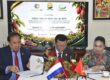
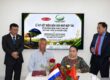
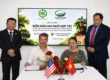
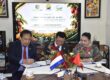
 The signing ceremony of the tripartite cooperation agreement on investment preparation, arrangement, and capital management for the Cacao – Chocolate Complex project in Dak Lak. Photo: LPF Fund.
Vietnam boasts large-scale production zones, a sizable farming workforce, numerous products with potential to integrate deeper into global value chains, and a substantial demand for capital dedicated to technology, deep processing, logistics, circular economy, and green transition.
If ESG is integrated right from the project design phase, green capital can generate impact far beyond conventional financial investments.
An investment designed with an ESG orientation does not merely aim to generate financial returns. Such capital can support enterprises in investing in new technologies, help establish more transparent raw material regions, assist farmers in transforming production methods, promote deep processing, optimize logistics, develop circular economies, and build supply chains capable of meeting international standards.
 The cocoa supply chain is not merely the story of a crop, but can become a pilot model for how ESG capital participates in restructuring agricultural value chains. Photo: LPF Fund.
This is why LPF Fund identifies sustainable agriculture as one of its key focus areas to build ESG capital connection models. The cocoa supply chain is seen as one of the practical models to test this approach.
Rather than focusing solely on expanding crop acreage, the cocoa ecosystem can be organized within a broader structure, from raw material areas and farmers/cooperatives to cultivation area data, preliminary processing and manufacturing, logistics, traceability, and ultimately, markets and green finance. When ESG is integrated throughout the value chain, every link can generate data and impact.
Farmers gain access to more sustainable production methods. Enterprises can secure stable and transparent raw material sources. Investors obtain stronger grounds to evaluate performance and impact. The market gains products that better meet origin and supply chain responsibility requirements.
As a result, cocoa is not merely the story of a crop, but can serve as a pilot model for how ESG capital participates in restructuring agricultural value chains.
An essential element in LPF Fund’s strategy is shifting the approach from “finding capital for projects” to building a system that qualifies projects to receive, manage, and utilize long-term capital.
This requires multiple competencies simultaneously: project selection, due diligence, legal standardization, ESG data construction, financial structuring, capital governance, implementation monitoring, impact measurement, and transparent reporting.
Therefore, LPF Fund defines its role not merely as a connection point. The broader objective is to co-create, standardize, build, manage, and develop green capital alongside domestic and international partners.
In doing so, LPF Fund can serve as a bridge between two ecosystems: the international capital community and the tangible project ecosystem in Vietnam.
Toward an ASEAN ESG Capital Community
To generate capital flows of sufficient scale for the green transition, a single organization is not enough. ASEAN needs a broader collaborative community comprising ESG investment funds, banks, development finance institutions, family offices, impact investors, enterprises, standards organizations, development agencies, technology providers, universities, and local authorities.
 LPF Fund at the honoring ceremony within the framework of the ASEAN Economic Forum 2026 and ASEAN Award 2026 in Singapore. Photo: LPF Fund.
Each participant can contribute distinct resources: capital, standards, technology, data, markets, governance expertise, or international networks. When these resources are placed on a transparent platform and aligned toward impact-generating projects, an “ASEAN ESG capital community” can take shape.
LPF Fund seeks to collaborate with partners to progressively foster this network, starting with concrete projects in Vietnam. Rather than connecting isolated deals, the long-term objective is to build an investable green project pipeline, where projects are standardized according to shared principles and equipped with sufficient data for evaluation by the international capital community.
Following the Singapore 2026 milestone, LPF Fund looks forward to expanding partnerships with financial institutions, ESG investment funds, development agencies, impact investors, standards organizations, and international enterprises sharing a common vision for sustainable development.
Various modes of cooperation can be explored: co-investment, blended finance, joint project development, technical assistance, technology transfer, ESG data development, market access, and resource management or fiduciary structures compliant with applicable legal frameworks and the governance standards of each party.
Vietnam can serve as the starting point. From models validated in Vietnam, LPF Fund aims to collaborate with partners to explore scaling to localities and countries with agricultural economies that face limited access to green capital across ASEAN and beyond. This is not merely about mobilizing additional capital; it is a process of building trust so that capital can reach further, stay longer, and create greater impact.
Phương Chi
Source: nongnghiepmoitruong.vn