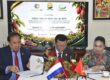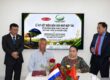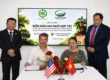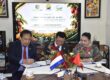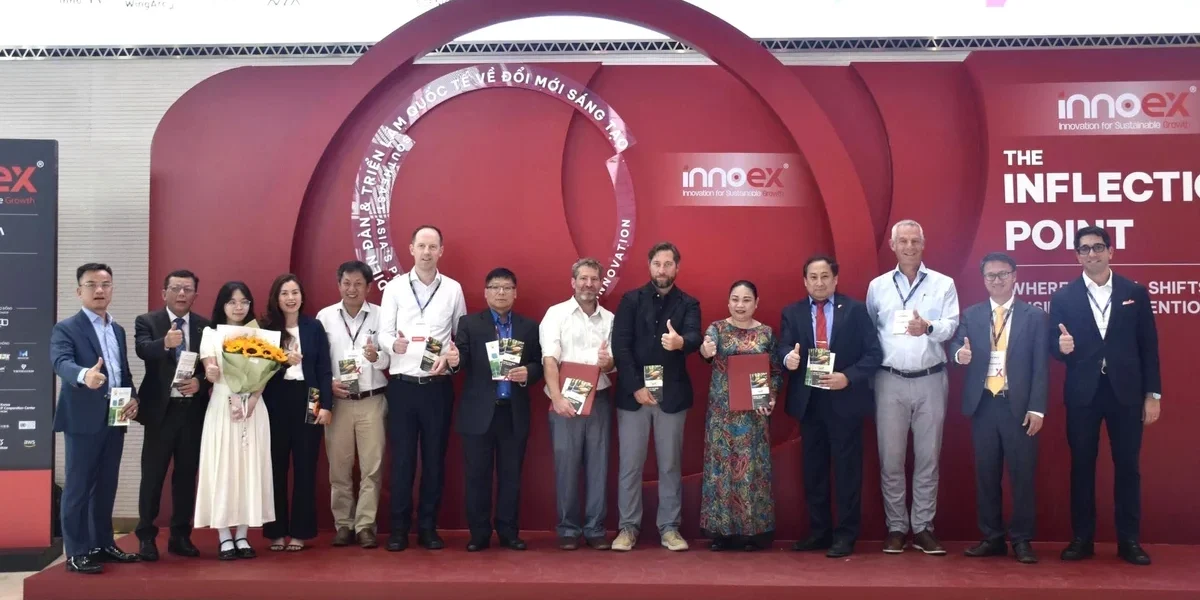
On August 19, LPF Fund, Golden Gate BCE, and Cacao Land signed a cooperation agreement to build an ESG cocoa ecosystem, connecting international technology and green capital.
Integrating Three Components into the ESG Ecosystem
Within the framework of the International Forum and Exhibition on Innovation and Sustainable Development held in Ho Chi Minh City on August 19–20, LPF Fund, Golden Gate BCE, and Cacao Land signed a tripartite cooperation agreement. The primary focus of the cooperation is coordinating investment preparation, arrangement, and capital management for the Cacao – Chocolate Complex Project in Dak Lak, while connecting appropriate investment components according to the orientation of the Vietnam Cocoa Industry Logistics Scheme proposed by LPF Fund.
 LPF Fund, Golden Gate BCE, and Cacao Land sign cooperation to build an ESG cocoa ecosystem. Photo: LPF Fund.
From a specific project, the three parties aim for a broader approach to progressively establish an ecosystem capable of connecting raw material areas, technology, deep processing, circular economy, logistics, markets, ESG, and green capital. Thereby, the model seeks to enhance the value of Vietnamese cocoa as well as its ability to access international standards, markets, and financial resources.
The cooperation model is established based on a clear division of roles among participating entities. Cacao Land focuses on developing project components, raw material areas, and the cocoa value chain, while collaborating with domestic and international technical partners to research and apply appropriate solutions for sustainable cocoa production. Golden Gate BCE assumes the coordinating and connecting role within the ecosystem, contributing to expanding the partner network along with suitable international cooperation structures.
Meanwhile, LPF Fund participates in project standardization, building suitable capital reception and management structures in Vietnam, coordinating financial structuring, capital governance and control, ESG, impact reporting, and linking the project with international capital structures. This division of roles creates the foundation for a cooperative model in which tangible projects, operational execution capabilities, ESG standards, and capital do not operate in isolation, but are situated within a unified development framework.
Making ESG a Practical Component of the Value Chain
A notable point in the three parties’ cooperation orientation is that ESG standards are approached directly from the actual operations of the cocoa value chain, rather than merely viewed as a set of criteria for reporting completion.
 The cooperation model is established based on a clear division of roles among participating entities. Photo: LPF Fund.
In the environmental pillar, the model aims to develop sustainable raw material areas, apply biological agriculture solutions, minimize waste, valorize byproducts, and research sustainable materials and packaging. In the social pillar, developing the cocoa chain linked to raw material areas helps enhance local product value, expand linkages between enterprises and production zones, and progressively improve stakeholders’ capacity to participate in the value chain. In the governance pillar, the focus is placed on project standardization, financial structure transparency, capital flow governance and control, ESG system construction, and impact reporting, thereby increasing the project’s readiness to meet the due diligence requirements of investors and financial institutions.
Alongside the tripartite agreement, Cacao Land and international partners are also executing technical cooperation activities aimed at researching and applying solutions for a sustainable cocoa chain. The first group of solutions focuses on biological agriculture to support farming, improve raw material area quality, and progressively access production methods aligned with green agriculture requirements. The second group of solutions targets the circular economy, including researching the procurement and utilization of byproducts, and developing sustainable materials and packaging for the cocoa value chain. This affirms that the Cacao – Chocolate Complex in Dak Lak is oriented as a central component featuring comprehensive linkages between raw material areas, technology, processing, logistics, markets, and capital sources.
Shifting the Mindset from “Needing Capital” to “Qualifying for Capital Access”
One of the major challenges addressed by the LPF Fund – Golden Gate BCE – Cacao Land cooperation model is the approach to capital for green agricultural projects. Instead of starting with the question of where capital comes from, the model aims to first resolve how a project needs to be standardized to qualify for capital access. Accordingly, a project must progressively fulfill requirements across legal frameworks, investment models, financial structures, capital flow governance, ESG criteria, impact measurability, and reporting mechanisms.
 The parties cooperate to build an ESG cocoa ecosystem connecting technology and green capital. Photo: LPF Fund.
This is also the role LPF Fund aims to play within the ecosystem: acting as the Vietnam focal point in standardizing projects, constructing capital reception and management structures within its legal purview, and coordinating on project readiness, documentation, financial structuring, ESG, and impact reporting. This standardization is expected to provide a foundation for qualified projects to progressively access banks, investment funds, development finance institutions, and domestic and international green capital sources.
From the tripartite cooperation, a cross-border connection model is also being explored. Under this orientation, investment, capital reception, and deployment activities in Vietnam must be organized in compliance with Vietnamese law. Meanwhile, accessing and structuring international capital can be carried out through overseas partners, financial institutions, investors, or appropriate investment structures, based on the principle that each entity is responsible only within its established functions, authority, and obligations. Notably, the tripartite cooperation agreement does not constitute an unconditional funding commitment, as any specific future funding depends on due diligence, approval processes, and separate definitive financial contracts, thereby ensuring transparency and risk management.
The presence of LPF Fund, Golden Gate BCE, and Cacao Land within a collaborative structure at the international event on August 19 extends beyond the ceremonial significance of a signing ceremony. More importantly, it represents the phased piloting of a model that connects local resources, international technology, and green capital, contributing to transforming ESG from standards into a practical component of sustainable agricultural development in Vietnam.
PV
Source: nongnghiepmoitruong.vn